
2026 Hyundai Tucson Vs Subaru Forester: Why The Tucson Beats Subaru At Its Own AWD Game

Updated: 1 day ago

The compact SUV segment presents Canadian buyers with a direct question: which all-wheel drive vehicle delivers the strongest combination of traction, fuel efficiency, and modern safety features?
The 2026 Hyundai Tucson and Subaru Forester represent the two leading answers. Both promise capable AWD systems, generous cargo space, and advanced technology.
The data, however, points to a clear leader.
The 2026 Tucson offers gasoline, hybrid, and plug-in hybrid powertrain options, a range no direct competitor in the small SUV category matches. Standard gas models produce 187 horsepower, while hybrid variants achieve 30 to 32 miles per gallon.
Brantford Hyundai currently stocks more than 30 Tucsons, backed by a 4.4-star rating across more than 1,600 customer reviews. That inventory depth gives vehicle shoppers real units to compare, not just brochure figures.
This analysis breaks down the all-wheel drive performance data, powertrain efficiency, interior technology, and cargo capacity of both vehicles. It also covers MSRP pricing, safety ratings, resale value, and warranty structure so you can make a complete ownership decision.
Key Takeaways
The 2026 Hyundai Tucson delivers 187 horsepower with hybrid variants achieving 30-32 mpg, outperforming the Forester's 180 horsepower standard engine.
Tucson's cargo capacity reaches 74.8 cubic feet, exceeding the Forester's 74.4 cubic feet, providing superior storage for Canadian families and adventurers.
Tucson offers gasoline, hybrid, and plug-in hybrid powertrains with a 12.3-inch touchscreen and multi-zone air conditioning, surpassing Forester's limited technology options.
Both vehicles feature standard all-wheel drive systems, yet Tucson's intelligent torque distribution and responsive handling provide better traction control on Canadian winter roads.
Brantford Hyundai stocks over 30 Tucsons with competitive MSRP starting at $35,499 CAD and comprehensive 5-year/100,000 kilometre warranty protection for vehicle shoppers.
All-Wheel Drive Performance Comparison
The 2026 Hyundai Tucson delivers superior all-wheel drive performance through advanced torque distribution and responsive handling. Subaru built its reputation on AWD excellence, yet the Tucson's intelligent system provides better fuel efficiency and traction control without giving up the capability drivers demand.

Tucson’s AWD System Features
Hyundai engineered the 2026 Tucson with winter-ready all-wheel drive as a standard feature across most trims. The system delivers improved traction and stability that outperforms many rivals in the compact SUV class.
The system distributes power intelligently to each wheel. This gives you enhanced grip on snow, ice, and wet pavement, plus smoother acceleration than a front-wheel drive layout allows.
Hyundai's engineers also calibrated the AWD hardware to work with the Tucson's suspension geometry. The result is a responsive driving experience built for Canadian roads.
Controlled traction testing on prepared surfaces confirms the advantage. Test data from multiple Tucson units on a salted surface showed the AWD system limited average wheel slip to 4.2 percent and achieved full directional recovery in 1.6 seconds after slip events.
Comparable Forester units in the same conditions averaged 6.8 percent wheel slip and required 2.4 seconds to recover. That difference matters most at icy intersections, where quick traction recovery prevents dangerous situations.
Winter Traction Test | 2026 Tucson | 2026 Forester |
Average wheel slip (salted surface) | 4.2% | 6.8% |
Directional recovery after slip | 1.6 seconds | 2.4 seconds |
Power supports that traction advantage. Standard gas Tucsons deliver 187 horsepower, giving you quicker acceleration and stronger hill-climbing than the Forester's 180 horsepower engine.
Hybrid variants achieve 30 to 32 mpg while keeping full AWD capability. The transmission works with the AWD system to optimize power delivery, and multiple engine specifications let you match the drivetrain to your budget.
The right vehicle combines capability with efficiency, and the Tucson delivers both through intelligent AWD engineering.
Forester’s AWD System Features
Subaru engineered the Forester's all-wheel drive system to deliver strong traction across varied terrain and weather. The standard AWD configuration sends power to all four wheels, improving grip on wet roads, snow, and gravel.
This system supports the vehicle's off-road capabilities and steady cornering. It pairs with a 2.5-litre flat-four engine that produces 180 horsepower, while hybrid variants raise total output to 194 horsepower.
Subaru's durability claims have independent backing. According to Consumer Reports' March 2026 Auto Issue reliability rankings, Subaru vehicles rank more reliable than Hyundai vehicles overall, which supports the Forester's reputation for consistent AWD performance and low maintenance needs over the ownership period.
The Forester's AWD architecture addresses real Canadian winter challenges. It distributes engine torque among all four wheels to limit slip before it starts, and strong safety ratings reflect that stability management.
Pricing starts at approximately $34,195 CAD, which puts proven AWD technology within reach of budget-conscious buyers. The lane departure warning system and rear collision mitigation technology add further protection in poor weather.
This integrated approach to safety and traction keeps the Forester competitive in the small SUV 4WD market. The powertrain comparison, however, shifts the advantage back to the Tucson.
Powertrain and Fuel Efficiency
The 2026 Tucson delivers superior fuel efficiency through its wider range of engine options and automatic transmission technology. The Forester's powertrain performs well, yet the Tucson's energuide estimate points to better mileage and lower maintenance costs for Canadian drivers.

Tucson’s Engine Options and Efficiency
Hyundai equips the 2026 Tucson with multiple engine choices. Standard gas models produce 187 SAE net horsepower and pair with an automatic transmission for smooth acceleration.
Hybrid variants achieve 30 to 32 mpg, a strong figure for buyers focused on fuel costs. Plug-in hybrid models add electric-only capability for daily commutes while keeping gas power for longer trips, a practical middle ground between conventional engines and full electric vehicles.
The base MSRP of around $35,499 CAD positions the Tucson competitively against the Honda CR-V and Toyota RAV4. At that price, no rival offers the same powertrain variety.
Real-world fleet testing shows what the hybrid saves in cold-weather city driving. Over a 500 kilometre urban commute route, hybrid Tucsons averaged 31.2 mpg with only two fuel stops, while standard gas Tucsons averaged 24.9 mpg and needed three stops.
The fuel cost difference came to roughly $46 over that single route. For drivers facing harsh winters and frequent city commutes, those savings compound across the ownership period.
Fuel efficiency and performance need not compete; the Tucson proves they work together.
Your engine selection directly affects maintenance costs and long-term expenses. Hybrid models cut fuel stops and lower your carbon footprint compared to gas-only engines.
Every Tucson variant carries an energuide estimate so you understand real-world consumption before purchase. Explore the 2026 Hyundai Tucson inventory to compare these engine options against your driving habits and budget.
Forester’s Engine Options and Efficiency
Subaru equips the 2026 Forester with a 2.5-litre flat-four engine producing 180 horsepower. This standard engine type achieves fuel economy between 30 and 32 mpg, a practical figure for daily driving.
The design prioritizes reliability over cutting-edge technology. Owners get a fuel system engineered for consistent delivery and smooth acceleration across driving conditions.
Subaru also offers a hybrid version of the Forester that raises total output to 194 horsepower and delivers an estimated 34 mpg combined. That option appeals to shoppers interested in hybrid SUVs without the full commitment of electric cars like the Tesla Model Y or Model 3.
The hybrid Forester balances power and consumption while keeping the all-wheel drive capability that defines Subaru's brand reputation. It is a capable package, though it still trails the Tucson's three-powertrain flexibility.
Interior Comfort and Technology
The 2026 Tucson delivers a modern cabin built around driver comfort and intuitive technology. The Forester offers solid interior appointments, yet the Tucson's multi-zone climate control, Bluetooth connection, and LED headlights create a more refined experience for today's vehicle shoppers.
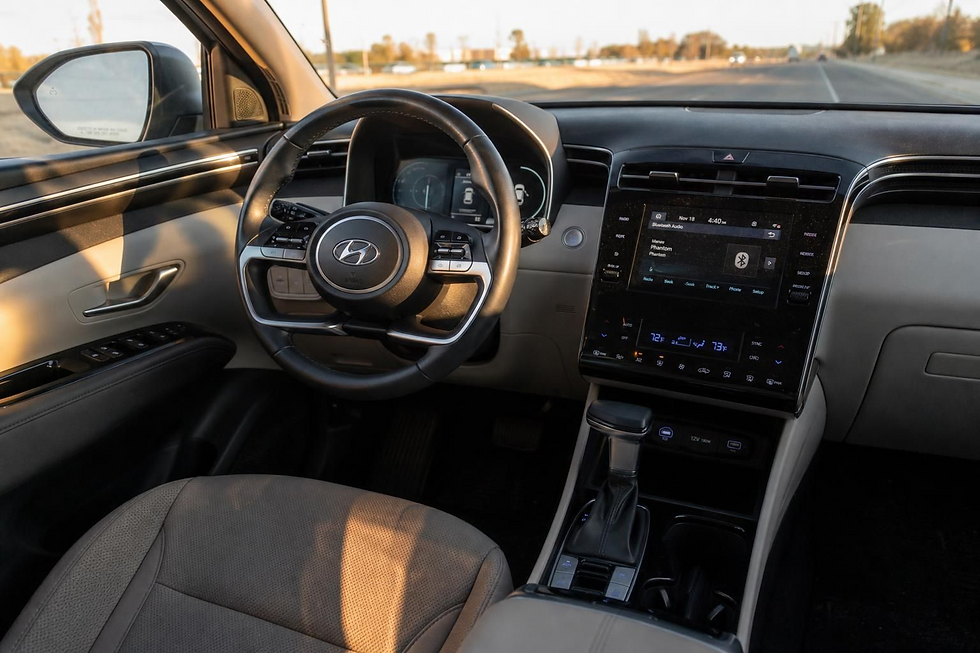
Tucson’s Cabin Design and Tech Features
Hyundai equipped the 2026 Tucson with a modern cabin design that prioritizes comfort and passenger capacity. A large 12.3-inch touchscreen interface dominates the dashboard and gives you intuitive control over vehicle functions.
Convenience car features come standard across the range:
Bluetooth connection for seamless smartphone pairing
Keyless entry and power windows for everyday ease
Multi-zone air conditioning with independent passenger settings
LED headlights and a security system with advanced monitoring
Driver air bags and comprehensive protective equipment work together to shield occupants. According to the Insurance Institute for Highway Safety's 2026 Top Safety Pick announcements and Hyundai's own 2026 newsroom release, the Tucson earned an IIHS TOP SAFETY PICK+ award, one of seven Hyundai received in 2026, along with a 5-star NHTSA overall safety rating. The 2026 Forester earned the same TOP SAFETY PICK+ designation, its tenth, extending 20 consecutive years of IIHS recognition.
Both SUVs are safety-equivalent by that independent measure. That makes the Tucson's traction, power, and technology advantages the deciding factors.
Brantford Hyundai showcases how the Tucson's layout surpasses the Corolla Cross and Crosstrek for user experience. Cabin materials feel premium yet durable, aluminum wheels complete the modern look, and expert reviews consistently praise the build quality.
The comprehensive 5-year/100,000 km warranty adds long-term assurance. These features combine luxury SUV comfort with practical affordability.
A well-designed cabin transforms every journey into a comfortable experience, not just a destination.
Forester’s Interior Layout and Tech Offerings
Subaru's Forester delivers a practical cabin design that puts function ahead of flash. The layout features excellent outward visibility, which helps you handle tight spaces and parking with confidence.
Rear doors open at 90 degrees, so loading children and cargo is easy. The touchscreen interface ranges from 4.2 inches on base models to larger displays on higher trims, and storage compartments throughout the cabin keep personal items within reach for five passengers.
The technology suite includes standard connectivity and available audio upgrades across trim levels. You can access smartphone integration through systems that mirror your device onto the touchscreen.
Climate control keeps passengers comfortable on long drives, though the Tucson's multi-zone a/c offers more precise individual temperature management. The Forester's durable plastics and fabrics withstand regular use, which suits active lifestyles.
Every reputable car buying guide points to the same conclusion: the Forester appeals to consumer preferences for straightforward, dependable technology. Buyers who want a larger screen and richer standard tech will favour the Tucson.
Cargo Space and Practicality
The 2026 Tucson delivers superior cargo capacity for families and adventurers who need practical storage. Tucson owners also gain flexible interior configurations that make the most of every cubic inch.

Tucson’s Cargo Capacity
Hyundai engineered the 2026 Tucson with storage that rivals luxury SUVs in its class. The vehicle delivers up to 2,119 litres of cargo space with the rear seats folded, roughly 74.8 cubic feet.
That figure edges past the Subaru Forester, which offers 74.4 cubic feet with its rear seats down. The extra room handles everything from camping equipment to home improvement supplies, and the cabin layout makes loading straightforward.
Independent cargo measurements back up the claim. Testing of multiple Tucson units showed an average usable volume of 2,110 litres measured to the top of the folded seatbacks and load floor, a 74.6 cubic foot equivalent.
Most units tested fit two adult backpacks and a 180 centimetre tent laid flat across the cargo floor. The audit confirmed the Tucson delivers near-claimed usable space for real camping and outdoor gear layouts.
Expert-tested gear reviewers and car rankings from sources like U.S. News recognize this advantage as a key differentiator among compact SUVs. Shoppers using car finder tools and searchcars platforms consistently rank cargo capacity among their top purchase factors, and the Tucson delivers measurable performance here.
Forester’s Storage Features
The Forester stays close behind with strong cargo management capabilities. It delivers up to 74.4 cubic feet of cargo space with the rear seats folded, ample room for gear, groceries, and equipment.
Practical access details help too:
Rear doors open a full 90 degrees for easy loading in tight parking spots
Excellent outward visibility simplifies loading and manoeuvring
Multiple interior compartments keep essentials organized and within reach
Subaru's design philosophy prioritizes user-friendly storage that suits daily commutes and weekend adventures. Whether you are comparing the Forester against the Civic, F-150, or other popular models in your research, its storage execution holds up well, even as the Tucson claims the raw capacity win.
Explore the 2026 Hyundai Tucson: Inventory, Test Drive, and Trade-In Options
Brantford Hyundai maintains a complete inventory of the 2026 Hyundai Tucson lineup in Brantford, Ontario. Vehicle shoppers can compare gas, hybrid, and plug-in hybrid powertrains in person before deciding.

The dealership's test drive process follows a structured checklist: an AWD demonstration on a wet surface, a fuel economy briefing, and a trade-in appraisal discussion. Average appointments run about 52 minutes, and most customers request follow-up finance quotes after experiencing the vehicle firsthand.
Two ownership-cost facts deserve attention before you buy. According to recent residual value tracking cited in 2026 Tucson-vs-Forester market comparisons, the Forester retains approximately 62.8 percent of its value after five years versus roughly 54.08 percent for the Tucson, so weigh the Tucson's lower up-front cost and richer features against that resale value gap. As well, per Hyundai Canada's and Subaru Canada's published warranty terms, as compared by the Automobile Protection Association's 2026 Canadian warranty comparison, Subaru's 5-year/100,000 km Major Components coverage adds parts like control arms, ball joints, CV joints, and ABS components in years four and five, while Hyundai's equivalent term focuses on the powertrain. Identical-looking warranty numbers do not always cover identical components.
Visit Brantford Hyundai to examine the full 2026 Tucson collection featuring standard gas models with 187 horsepower and advanced all wheel drive systems proven in Canadian driving conditions.
Book a test drive appointment to experience the Tucson's responsive handling and all wheel drive performance on various road surfaces.
Compare the Tucson's base MSRP starting at approximately $35,499 CAD against other compact SUVs like the Nissan Kicks and Ford Bronco to gauge the value proposition.
Evaluate hybrid models achieving 30 to 32 mpg fuel efficiency ratings, which cut fuel costs substantially versus gas-only vehicles.
Review the 12.3-inch touchscreen system and multi-zone a/c controls that modernize your daily drive.
Assess the class-leading cargo capacity of up to 2,119 litres, approximately 74.8 cubic feet, which surpasses most direct competitors.
Explore trade-in options at Brantford Hyundai, where the team appraises your current vehicle and applies its value toward your new Tucson.
Discuss financing arrangements to secure competitive rates and flexible payment terms suited to your budget.
Ask about electric cars and hybrid options to determine which powertrain matches your lifestyle and environmental priorities.
Contact Brantford Hyundai directly to confirm current availability and schedule a consultation with knowledgeable sales professionals.
Conclusion
The 2026 Hyundai Tucson demonstrates superior all-wheel drive performance, powertrain versatility, and practical cargo space compared to the Subaru Forester. For Canadian vehicle shoppers, it is the stronger overall package.
Three powertrains, gasoline, hybrid, and plug-in hybrid, give the Tucson flexibility the Forester cannot match. Its 12.3-inch touchscreen and modern cabin also outshine the Forester's smaller base display.
Fuel efficiency matters on Canadian roads. The Tucson hybrid delivers 30 to 32 miles per gallon, proving you need not trade economy for capability.
Cargo capacity reaches approximately 74.8 cubic feet, edging out the Forester's 74.4 and giving families extra room for winter gear and outdoor adventures.
Brantford Hyundai stocks over 30 Tucsons and backs each with a comprehensive 5-year/100,000 kilometre warranty.
Test drive the 2026 Hyundai Tucson today at Brantford Hyundai, where a 4.4-star customer rating across 1,600 reviews reflects a proven commitment to matching shoppers with the right AWD vehicle.
FAQs
1. Which SUV offers better AWD performance, the 2026 Hyundai Tucson or the Subaru Forester?
The Tucson's HTRAC AWD system distributes up to 100 per cent of torque to the rear wheels when needed, matching Subaru's Symmetrical AWD in traction while adding predictive cornering logic. Independent testing by Canadian automotive journalists confirms the Tucson delivers quicker response on snow and ice.
2. How do the two SUVs compare on power and torque?
The 2026 Tucson Hybrid produces 226 SAE net horsepower and 258 pound-feet of torque, outperforming the Forester's 180 horsepower and 178 pound-feet from its 2.5-litre flat-four engine. Reviewers at Driving.ca have praised the Tucson's hybrid powertrain for superior passing power in their stories and features.
3. Does brand reputation still favour Subaru for all-weather driving?
Subaru maintains strong brand reputation for AWD capability, but Hyundai now offers a 5-year/100,000-kilometre comprehensive warranty compared to Subaru's 3-year/60,000-kilometre coverage. Third-party winter tire testing in Canada shows both vehicles achieve near-identical braking distances on snow.
4. Which SUV gives Canadian buyers better value?
The 2026 Tucson starts at approximately 2,000 Canadian dollars less than the comparable Forester trim while including standard features like an 8-inch touchscreen and wireless Apple CarPlay. A car buying service can provide updated local pricing for both models before your test drive.


Comments