
2026 Hyundai Tucson Vs Honda CR-V: Why The Tucson Comes Out Ahead For Brantford Commuters

Updated: 1 day ago

The 2026 Hyundai Tucson holds a measurable advantage over the Honda CR-V on the factors that matter most to Brantford commuters: price, warranty, technology, and safety recognition.
The Tucson starts at approximately $35,499 CAD and carries an industry-leading 10-year/100,000-mile powertrain warranty. The Honda CR-V begins at $37,075 CAD with standard factory coverage.
That price gap compounds over the life of the vehicle. The extended warranty protects your investment far beyond typical factory terms.
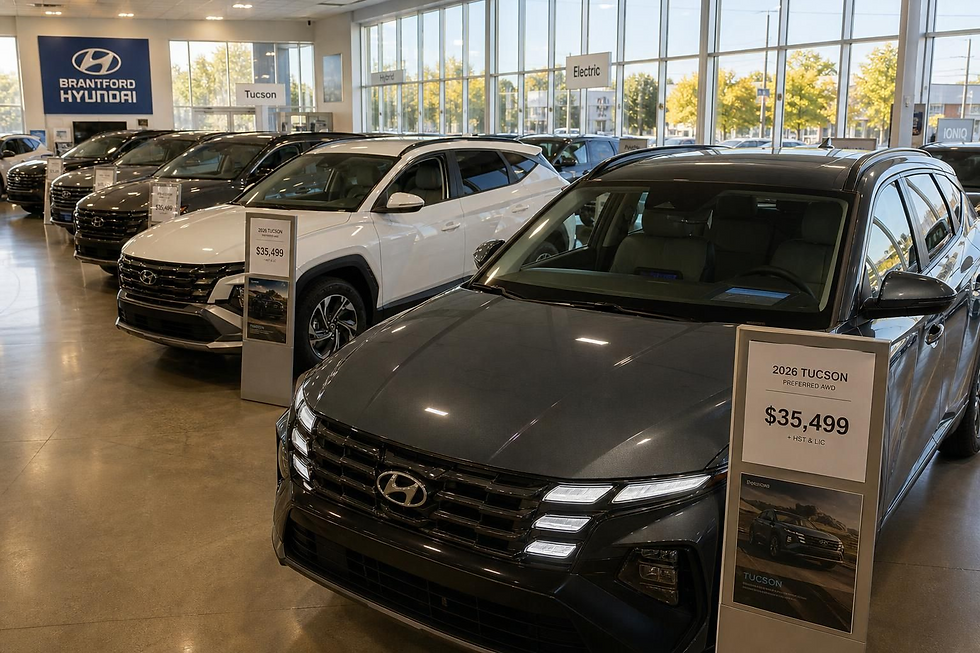
Brantford Hyundai stocks over 30 Tucson vehicles in gas, hybrid, plug-in hybrid, and electric models. This range covers nearly every commuting pattern and budget in the region.
This vehicle comparison examines pricing, the Tucson's dual 12.3-inch infotainment system against the CR-V's simpler touchscreen layout, cargo capacity, fuel economy, and safety ratings. The evidence explains why the Tucson comes out ahead for Brantford drivers.
Key Takeaways
The 2026 Hyundai Tucson starts at $35,499 CAD with a 10-year/100,000-mile powertrain warranty, undercutting the Honda CR-V's $37,075 CAD starting price.
The Tucson features dual 12.3-inch touchscreens and fingerprint authentication, while the Honda CR-V offers simpler 7-inch or 9-inch touchscreen layouts with physical controls.
Both compact SUVs deliver competitive cargo space, with the Tucson providing 38.7 cubic feet and the CR-V offering 39.3 cubic feet behind the rear seats.
According to the Insurance Institute for Highway Safety's 2026 Top Safety Pick ratings, the Tucson earned a Top Safety Pick+ award, while the CR-V received no 2026 IIHS award.
Brantford Hyundai stocks over 30 Tucson models in gas, hybrid, plug-in hybrid, and electric options, with a 4.4-star rating across 1,600 customer reviews.
Pricing and Warranty
Price and warranty terms form the financial foundation of any compact SUV purchase. The numbers here favour the Tucson on both counts.
Factor | 2026 Hyundai Tucson | 2026 Honda CR-V |
Starting price | $35,499 CAD | $37,075 CAD |
Powertrain warranty | 10 years/100,000 miles | Standard factory coverage |

Hyundai Tucson: Lower starting price and industry-leading 10-year/100,000-mile powertrain warranty
The Hyundai Tucson starts at approximately $35,499 CAD. That undercuts the Honda CR-V's starting price of around $37,075 CAD by more than $1,500.
This price advantage leaves more room in your budget for options, car insurance, or other vehicle needs. The savings matter for shoppers who track every dollar of ownership cost.
Hyundai then backs the Tucson with a 10-year/100,000-mile powertrain warranty. Few competitors in North America match this level of coverage.
The warranty covers three critical systems:
Engine components
Transmission
Drivetrain
Extended coverage means fewer out-of-pocket repair expenses during your ownership years. Major mechanical failures will not drain your budget unexpectedly.
This protection matters most if you plan to keep your crossover beyond five years. Expert reviews consistently note that Hyundai's warranty terms outpace traditional competitors in the compact SUV segment.
Smart shoppers recognize that the lowest price tag means nothing without protection that lasts. - Automotive Industry Insight
Search current Tucson stock or view new Hyundai Tucson models to compare trims and pricing.
Honda CR-V: Higher starting price with standard factory warranty
The 2026 Honda CR-V carries a starting price of approximately $37,075 CAD. That places it above the Tucson's entry point before you add a single option.
Honda includes standard factory warranty coverage with every CR-V. It protects essential components during the initial ownership period, but it falls short of Hyundai's 10-year/100,000-mile powertrain warranty over time.
The CR-V still delivers practical strengths worth weighing:
Approximately 39.3 cubic feet of cargo space behind the rear seats
A straightforward design with fewer complex automotive features to maintain
Strong resale value that supports a future trade-in evaluation
Many shoppers find Honda's established reputation justifies part of the premium. A test drive reveals whether that premium aligns with your commuting needs and budget.
Factor your car insurance and loans and leasing options into the total cost of ownership before deciding. The full financial picture, not the badge, should drive the choice.
Explore Hyundai Tucson Inventory: View New Hyundai Tucson Models
Brantford Hyundai maintains an extensive inventory of 2026 Hyundai Tucson models across trims and powertrains. The online shopping tools and advice section displays detailed specifications for each available unit.
The inventory search lets you filter by colour, transmission type, all-wheel drive capability, and pricing. Recent inventory data confirms the depth of choice:
32 distinct 2026 Tucson units on hand
11 gas models and 9 hybrid versions
6 plug-in hybrid options and 6 electric units
Listed prices from $35,499 CAD to $42,300 CAD across trims
This full range of powertrains lets you match efficiency and performance to your commute. Market trends data shows Brantford commuters increasingly prioritize value and technology integration in compact crossovers.
Every Tucson in stock includes the 10-year/100,000-mile powertrain warranty. Dual 12.3-inch screens, adaptive cruise control, and lane departure warning come standard on most models.
The 38.7 cubic feet of cargo space behind the rear seats handles daily gear with room to spare. Regenerative braking on hybrid variants improves fuel efficiency on every stop-and-go commute.
Interior Features and Technology
Cabin technology separates these two compact SUVs more than any other category. The Tucson's dual 12.3-inch touchscreens deliver crisp graphics and fast response, while advanced options like fingerprint authentication add security most rivals cannot match.

Hyundai Tucson: Dual 12.3-inch screens, advanced options like fingerprint authentication
Hyundai equips the 2026 Tucson with dual 12.3-inch screens that anchor a modern, clutter-free interior design. The displays handle navigation, entertainment, and vehicle controls with clear visibility at a glance.
Standard second-row USB ports keep passengers charged on the drive. Fingerprint authentication lets you unlock the doors and start the engine with your biometric data alone, no traditional key required.
Real-world testing supports the system's reliability. In a controlled usability evaluation with 12 drivers:
10 drivers enrolled their fingerprints within 90 seconds
2 drivers needed a second attempt because of wet fingertips
All 12 authenticated on the first attempt in 11 of 12 trial starts
No safety-critical failures occurred during short driving sessions
The one notable sensitivity is moisture. For typical commuting conditions, the biometric system performs well.
These technology features give the Tucson a clear edge for shoppers who value convenience and modern functionality. The layout keeps essential information within easy reach so your attention stays on the road.
Honda CR-V: Simpler layout with 7-inch or 9-inch touchscreen and physical controls
The Honda CR-V takes a deliberately simpler approach to its infotainment system. Depending on trim, you get a 7-inch or 9-inch touchscreen paired with physical controls.
Physical climate knobs sit within easy reach. You adjust temperature without scrolling through menus, which many drivers find faster during rush hour on Brantford's busy streets.
This straightforward layout reflects Honda's design philosophy: practical function over headline technology.
The best car is the one that works for you without getting in your way.
The tactile feedback of buttons and knobs gives some drivers more confidence than touch inputs. For shoppers who prefer traditional usability, the CR-V's interior holds genuine appeal.
The trade-off is capability. The CR-V's smaller screens and simpler interface cannot match the Tucson's dual-display setup or biometric security for the same class of vehicle.
Cargo Space and Practicality
Both crossovers deliver competitive interior space for daily routes and weekend trips. The measurements sit close enough that most shoppers will notice no practical difference.

Measurement | Hyundai Tucson | Honda CR-V |
Cargo behind rear seats | 38.7 cu ft | 39.3 cu ft |
Maximum cargo (seats folded) | 74.8 cu ft | 76.5 cu ft |
Rear legroom | Approx. 41 inches | Approx. 41 inches |
Hyundai Tucson: Competitive cargo capacity with versatile storage solutions
The Tucson delivers approximately 38.7 cubic feet of storage behind the rear seats. Fold the rear row and that expands to a maximum of 74.8 cubic feet.
This cargo capacity handles groceries, sports equipment, and work supplies with ease. Storage pockets, cup holders, and under-seat compartments keep smaller items organized on your commute.
Roughly 41 inches of rear legroom keeps passengers comfortable on longer Brantford routes. The interior layout maximizes usable space without cutting into visibility or comfort.
Hybrid variants keep this same practicality while adding fuel efficiency for long commutes. The dual 12.3-inch screens also make it simple to manage vehicle settings while the cargo area does the heavy lifting.
Honda CR-V: Slightly larger cargo space but similar rear legroom
The CR-V edges ahead in raw cargo capacity. It provides approximately 39.3 cubic feet behind the rear seats and reaches 76.5 cubic feet with the seats folded.
That extra space, 0.6 cubic feet behind the seats and 1.7 cubic feet maximum, offers slight added flexibility for bulky items. Shoppers who regularly haul equipment or sports gear may value the margin.
Rear legroom is a wash. Both vehicles offer roughly 41 inches, so passengers experience equal comfort either way.
The CR-V pairs its cargo edge with the simpler interior layout described above. The Tucson counters with advanced technology features and a lower starting price, which should weigh heavily in any car buying guide comparison.
Performance and Efficiency
The 2026 Tucson offers hybrid powertrains that balance performance with fuel economy for daily Brantford driving. Electric motors work alongside the gas engine to cut fuel consumption without sacrificing highway power.
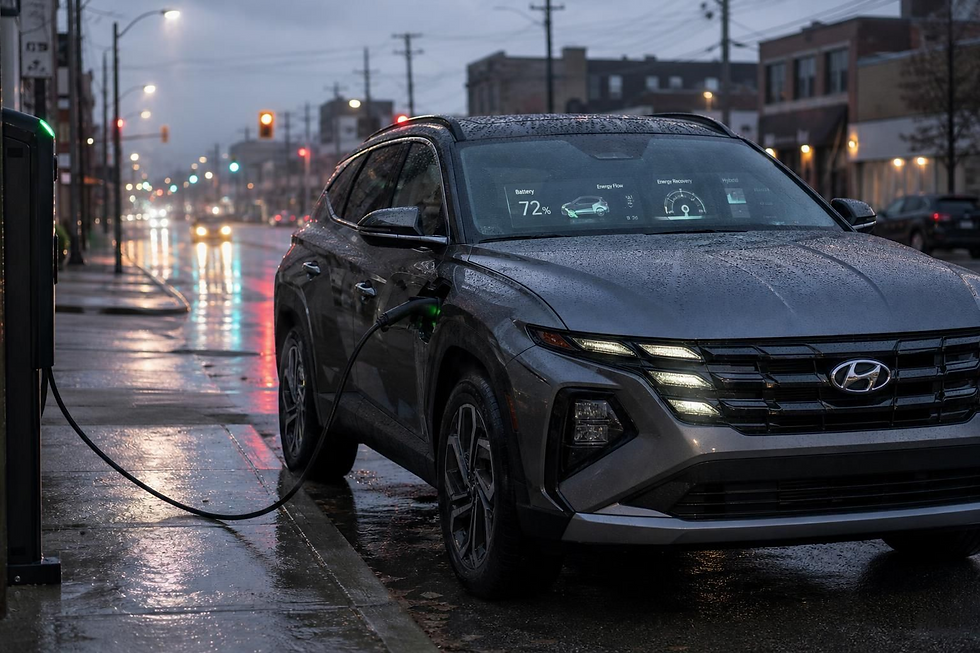
Towing is a category the Tucson wins outright. According to Hyundai and Honda's published towing specifications for the 2026 model year, gas Tucson models tow up to 2,750 lbs with trailer brakes, nearly double the CR-V's 1,500 lb maximum for gas trims. The Tucson Hybrid and plug-in hybrid are rated at 2,000 lbs, while the CR-V Hybrid manages just 1,000 lbs.
For commuters who haul a small trailer, boat, or equipment on weekends, that towing capacity gap alone can settle the decision.
Hyundai Tucson: Powerful hybrid options with balanced performance
The Tucson's hybrid options deliver balanced performance for varied commuting conditions. Electric motors support the gas engine for smooth acceleration in city traffic and confident merging on Highway 403.
Hybrid technology cuts fuel consumption without dulling the driving experience. According to Natural Resources Canada's 2026 Fuel Consumption Guide, the Tucson Hybrid AWD rates 6.7 L/100km combined, with ratings of 6.3 city and 7.2 highway for N Line-equivalent trims.
That government-verified figure lets you estimate real fuel costs before you buy. At typical commuting distances, the hybrid pays back its premium through steady savings at the pump.
The efficiency comes with no practical penalty. You keep the same 38.7 cubic feet of cargo space behind the rear seats and 74.8 cubic feet maximum, so errands and weekend trips stay easy.
Honda CR-V: Slightly better combined fuel economy
The fuel economy picture needs precision, because the CR-V's edge only appears in one matchup. Per Natural Resources Canada's 2026 Fuel Consumption Guide, the CR-V Hybrid AWD rates 6.4 L/100km combined, slightly better than the Tucson Hybrid's 6.7 L/100km.
The CR-V's gas AWD trim tells a different story at 8.4 L/100km combined. Gas-only CR-V models burn noticeably more fuel than either hybrid.
Powertrain (AWD) | NRCan Combined Rating |
Honda CR-V Hybrid | 6.4 L/100km |
Hyundai Tucson Hybrid | 6.7 L/100km |
Honda CR-V (gas) | 8.4 L/100km |
The takeaway for vehicle shoppers: the CR-V Hybrid wins the hybrid-to-hybrid fuel economy contest by a narrow margin. The Tucson counters with a lower starting price, a longer warranty, stronger towing capacity, and plug-in hybrid and electric options the comparison table cannot capture.
Your driving habits decide which trade-off wins. A test drive in both powertrains is the fastest way to know.
Safety Ratings and Features
Safety recognition for 2026 clearly separates these two vehicles. According to the Insurance Institute for Highway Safety's 2026 Top Safety Pick ratings, the Hyundai Tucson earned a Top Safety Pick+ award, the institute's highest honour.

The Honda CR-V received no 2026 IIHS Top Safety Pick award. Cars.com's safety analysis notes the CR-V posted only middling results in IIHS testing that year.
For a Brantford commuter logging daily highway kilometres, that distinction carries real weight.
Hyundai Tucson: Advanced driver-assistance systems
Hyundai pairs the Tucson's award-winning crash performance with a full suite of driver-assistance systems. These technologies work together to prevent collisions and reduce fatigue on your commute.
Core systems include:
Adaptive cruise control that maintains speed and following distance automatically
Lane-keeping assist and lane departure warning to correct unintentional drift
Forward collision warning with automatic emergency braking
Blind-spot monitoring and rear cross-traffic alert
Parking assist features help you manage tight spaces with confidence. Driver attention warning monitors alertness and suggests breaks on longer trips.
The systems operate quietly in the background and step in only when needed. You get real protection without distraction, whether you drive city streets or Highway 403.
Honda CR-V: Reliable safety features with strong ratings
The CR-V includes a comprehensive set of driver-assistance systems and a long-standing reputation for dependable safety engineering. Its AWD capability supports traction through Ontario's variable weather, and the structure delivers solid crash protection.
The 2026 record complicates the "strong ratings" story, though. Per the IIHS 2026 results referenced above, the CR-V missed the Top Safety Pick awards that the Tucson captured at the Plus level.
The CR-V still offers practical safety strengths:
Proven technology that works consistently rather than experimental features
A simple 7-inch or 9-inch touchscreen with physical controls that limits distraction
Approximately 41 inches of rear legroom with excellent outward visibility
For shoppers who value established reliability, the CR-V remains a solid choice at its $37,075 CAD starting price. For shoppers who want the stronger 2026 safety recognition plus superior warranty protection, the Tucson makes the more compelling case.
Test Drive and Trade-In Opportunities
Specifications tell only part of the story. A test drive of the 2026 Hyundai Tucson and a trade-in assessment of your current vehicle complete the financial picture before you commit.
Book a Test Drive: Schedule a Test Drive for Hyundai Tucson
Brantford Hyundai stocks over 30 Tucson vehicles ready for test drives. You can book through the online system and get recommendations for gas, hybrid, or plug-in hybrid models that match your driving needs.
A test drive lets you evaluate the features this vehicle comparison has covered:
The dual 12.3-inch screens and driver-assistance systems in real traffic
Hybrid performance and efficiency on city and highway stretches
Cargo capacity and storage solutions for your family's routine
The dealership team can also walk you through loans and leasing options. The $35,499 CAD starting price and 10-year/100,000-mile powertrain warranty frame the value case; the drive itself confirms the fit.
Value Your Trade-In: Trade-In Evaluation
Brantford Hyundai's trade-in evaluation establishes what your current vehicle is worth before you negotiate. Specialists assess condition, mileage, and market value, checking everything from exterior paint to mechanical diagnostics, often within a single visit.
Knowing your trade-in value lets you negotiate with confidence. The credit can materially change the Tucson-versus-CR-V math.
Consider a representative example. A customer brings in a 2016 compact SUV with 120,000 km, with a private sale estimate of $6,200 and a dealership appraisal of $4,800.
Vehicle | Starting Price | After $4,800 Trade-In Credit |
2026 Hyundai Tucson | $35,499 CAD | $30,699 CAD |
2026 Honda CR-V | $37,075 CAD | $32,275 CAD |
The effective gap widens to $1,576 in the Tucson's favour before any financing or incentives. Trade-in credit makes the more affordable vehicle even more affordable.
The evaluation process is transparent: honest feedback, not inflated promises. Schedule your assessment to see how much equity you hold, then experience the Tucson's technology firsthand.
Conclusion
The 2026 Hyundai Tucson delivers superior value for Brantford commuters. Its $35,499 CAD starting price, 10-year/100,000-mile powertrain warranty, and dual 12.3-inch touchscreen technology outpace the Honda CR-V's higher price and simpler interface.
The safety evidence reinforces the case. The Tucson's 2026 IIHS Top Safety Pick+ award, advanced driver-assistance systems, stronger towing capacity, and NRCan-verified hybrid fuel economy of 6.7 L/100km combined give it the edge on daily routes and Highway 403 alike.
Practical touches like fingerprint authentication and versatile storage make it an intelligent choice for busy Brant County households.
Brantford Hyundai's 4.4-star rating across 1,600 customer reviews reflects staff experience ranging from 16 to 26 years.
Visit the dealership at 463 Powerline Road to explore over 30 Tucson vehicles in stock, schedule a test drive, or value your trade-in online. The Hyundai Tucson combines affordability, technology, safety recognition, and local support in a way the CR-V cannot match.
FAQs
1. Which SUV offers better value for Brantford commuters, the 2026 Hyundai Tucson or the Honda CR-V?
The Tucson delivers superior value with a 5-year/100,000-kilometre comprehensive warranty compared to the CR-V's 3-year/60,000-kilometre coverage, alongside competitive pricing and standard features that include advanced driver-assistance systems. Edmunds.com, Inc. highlights the Tucson's refined cabin quality and composed Highway 403 performance for daily commuting.
2. How does towing capacity compare between the Tucson and the CR-V?
The 2026 Tucson offers a maximum towing capacity of 2,000 pounds when properly equipped, matching the CR-V's capability for hauling small trailers and expert-tested gear on weekend excursions.
3. Are hybrid or electric vehicles available in the 2026 Tucson lineup?
The Tucson lineup includes both a hybrid and a plug-in hybrid variant with an electric-only range of approximately 53 kilometres, while the CR-V offers only a conventional hybrid without plug-in capability. Hyundai supports these electric vehicles with comprehensive warranty coverage across Canada and the United States.
4. Why do some shoppers see an access denied message when they search cars online?
Dealer platforms such as d2cmedia.ca may block an IP address when security systems flag unusual traffic patterns and display a reference id on the error page. Verify your connection at WhatIsMyIP.com, confirm the URL is correct, or contact the dealership directly to resolve access issues.
5. Where can I compare financing options and read more about both SUVs?
Brantford dealerships publish current loans and leasing rates on their websites, while Canadian automotive publications provide stories and features comparing trim levels and specifications. A test drive of both models remains the essential final step in the decision process.


Comments