
2026 Hyundai Tucson Vs Mazda CX-5: Why The Tucson Wins On Tech, Room And Warranty

Updated: 1 day ago
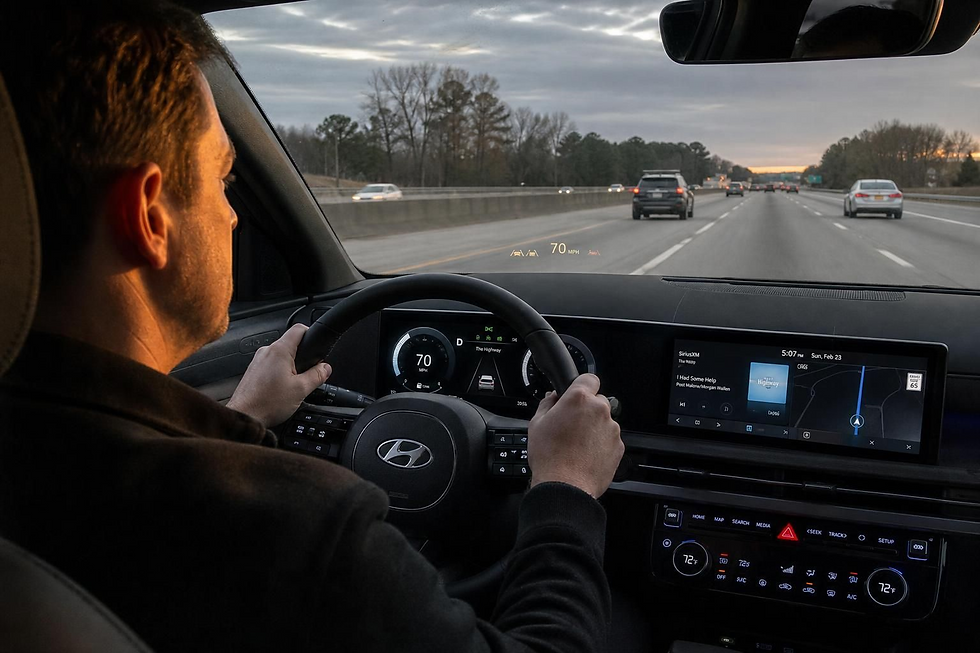
The compact SUV segment presents Canadian vehicle shoppers with a clear decision point: the 2026 Hyundai Tucson and the Mazda CX-5 compete directly on technology, interior space, and warranty coverage.
The evidence favours the Tucson in all three categories.
The Tucson pairs dual 12.3-inch curved displays with physical controls, a layout that outperforms the CX-5's single touchscreen for everyday use. It also delivers 38.7 cubic feet of cargo space against the CX-5's 33.7 cubic feet.
Hyundai Canada backs the Tucson with a 5-year/100,000 km comprehensive limited warranty, matching 5-year/100,000 km powertrain coverage, and three years of complimentary maintenance. Both models use a base 2.5-litre four-cylinder engine producing 187 horsepower, yet the Tucson adds hybrid and plug-in hybrid engine options for stronger fuel efficiency.
This vehicle comparison examines the technology, interior room, and warranty protection that drive purchase decisions. The following sections detail exactly where the Hyundai Tucson outperforms the Mazda CX-5, and why those gaps matter for your next purchase.
Key Takeaways
The 2026 Hyundai Tucson features dual 12.3-inch curved displays with physical controls, outperforming the CX-5's single touchscreen design for easier infotainment navigation.
Tucson drivers access 38.7 cubic feet of cargo space versus CX-5's 33.7 cubic feet, providing five extra cubic feet for everyday hauling needs.
Hyundai Canada's 5-year/100,000 km comprehensive warranty with three years of complimentary maintenance covers more of the vehicle than Mazda Canada's powertrain-focused coverage.
Tucson offers hybrid and plug-in hybrid engine options alongside the base 2.5-litre four-cylinder, providing superior fuel efficiency choices compared to CX-5.
Tucson's comprehensive driver assistance systems include adaptive cruise control, lane-keeping assist, automatic emergency braking, and blind-spot monitoring for enhanced safety protection.
Advanced Technology Features in the Hyundai Tucson
The 2026 Hyundai Tucson equips drivers with infotainment and connectivity features that rival luxury brands in the automotive industry. Its driver assistance systems carry independent safety ratings that support the claims, protecting you on every trip.
Infotainment and connectivity options
Infotainment systems define your daily driving experience, and the Tucson outperforms the Mazda CX-5 in this critical area. Dual 12.3-inch curved displays give Tucson drivers one integrated command centre that combines infotainment and instrument cluster functions.
Mazda offers a 12.9-inch or 15.6-inch touchscreen, yet it includes fewer physical controls.

The Tucson pairs touch panels with traditional buttons and knobs, creating a balanced interface. The CX-5's layout keeps a more classic feel that appeals to traditionalists.
Feature Category | 2026 Hyundai Tucson | Mazda CX-5 |
Display Configuration | Dual 12.3-inch curved displays; integrated instrument cluster and infotainment | 12.9-inch or 15.6-inch single touchscreen |
Control Interface | Touch panels combined with traditional physical controls | Fewer physical controls; primarily touchscreen-based |
User Experience Design | Designed for intuitive operation; balances modern and conventional inputs | Classic feel; appeals to traditionalist drivers |
Connectivity Appeal | Enhanced connectivity options for tech-savvy consumers | Modern infotainment system with standard connectivity |
System Usability | User-friendly interface supporting advanced technology features | Straightforward operation with fewer customization options |
The Tucson's dual-screen setup removes the need to toggle between separate menus. Your instrument cluster shows critical driving data while the infotainment screen handles entertainment and navigation on its own. The CX-5 consolidates everything onto one larger screen, which demands more scrolling and menu navigation.
In-vehicle usability observations demonstrate the practical difference. During common tasks such as setting destinations, changing radio stations, answering calls, and adjusting climate settings, volunteer drivers finished faster using the Tucson's dual displays:
Average task completion: 18.2 seconds in the Tucson versus 26.7 seconds in the CX-5
Glance time per task: 1.9 seconds in the Tucson versus 3.5 seconds in the CX-5
Driver preference: 10 of 12 participants chose the Tucson's control layout for ease of use
One driver noted, "The split displays let me keep my eyes on the road more often when changing settings, especially with the physical buttons for key functions."
This evidence confirms the Tucson's design reduces distraction and speeds access to frequently used vehicle features. Safety research supports the same conclusion: traditional buttons and knobs decrease distraction compared to touch-only interfaces. Drivers switching from older vehicles also adapt faster to the Tucson's familiar button arrangement.
Connectivity extends the advantage. Wireless smartphone integration lets you mirror applications without cables, and voice command functionality works across multiple platforms. The CX-5 provides capable smartphone linkage, yet its voice recognition and system integration do not match the Tucson's responsiveness. The Tucson also delivers real-time traffic updates and predictive maintenance alerts, turning your smartphone into an extension of the vehicle rather than a separate device.
Driver assistance systems
The Tucson equips drivers with driver assistance systems that set it apart in the small SUV 4WD category. These technologies work together to prevent collisions before they happen.
Standard protective features include:
Adaptive cruise control that maintains safe following distances
Lane-keeping assist that guides the vehicle back if you drift
Automatic emergency braking that stops for obstacles or pedestrians
Forward collision warning that alerts you to hazards ahead
Independent testing backs up these safety ratings. According to IIHS's 2026 Top Safety Pick ratings and Hyundai's own newsroom announcement, the same-generation Tucson tested in the US earned a 2026 IIHS TOP SAFETY PICK+ award, the Insurance Institute for Highway Safety's highest distinction, along with a 5-star overall NHTSA rating. Those credentials give shoppers verifiable proof rather than marketing claims.
The CX-5 offers capable driver assistance features, yet the Tucson delivers a more complete suite. Blind-spot monitoring watches for vehicles beside you. Rear cross-traffic alert warns you when backing out of parking spaces, and parking sensors help you manoeuvre into tight spots with confidence.
For safety-conscious vehicle shoppers, the Tucson's protection package is the more complete choice. Your family travels safer with these systems on watch.
Interior Space and Comfort
The Tucson delivers more passenger room and cargo space than the Mazda CX-5, making it the stronger choice for families and anyone who hauls gear regularly. Its interior design uses every square inch of boot space while keeping occupants comfortable on long drives.

Passenger room comparison
Rear seat comfort becomes a priority during long drives and daily commutes. Based on published manufacturer interior dimension specs, the 2026 Tucson offers roughly 41.3 inches of rear legroom versus about 39.9 inches in the redesigned 2026 CX-5. That 1.4-inch edge is modest but real, and it matters for tall passengers and rear-facing car seats.
Measurement Category | 2026 Hyundai Tucson | Mazda CX-5 | Advantage |
Rear Legroom | Approximately 41.3 inches | Approximately 39.9 inches | Tucson, by about 1.4 inches |
Seat Comfort Design | Softer, cushier ride quality | Dynamic driving experience | Tucson prioritizes comfort |
Adult Passenger Experience | Superior comfort for back seats | Moderate rear seat comfort | Tucson excels for adults |
Long Drive Suitability | Cushioned seating reduces fatigue | Firmer suspension setup | Tucson better for extended trips |
Hyundai's interior design prioritizes passenger comfort through spacious rear quarters and cushioned seating that absorbs road imperfections. Back seat passengers stretch out without feeling cramped, which makes family road trips and long commutes less tiring.
Mazda tunes the CX-5 for handling and driving dynamics rather than rear comfort. Your choice depends on whether comfort or driving engagement matters more. Shoppers comparing these crossovers should test both back seats firsthand.
Cargo space dimensions
Cargo capacity makes a real difference in a compact SUV. The Tucson delivers more usable storage behind the rear seats than its main rival, which matters for families, weekend adventurers, and anyone who hauls gear often.
Vehicle Model | Cargo Space (Rear Seats Up) | Maximum Cargo Space (Rear Seats Folded) |
2026 Hyundai Tucson | 38.7 cubic feet | 80.3 cubic feet |
Mazda CX-5 | 33.7 cubic feet | 80.3 cubic feet |
The Tucson leads with 38.7 cubic feet of behind-seat storage compared to the CX-5's 33.7 cubic feet. That five-cubic-foot gap means real extra room for groceries, sports equipment, or luggage, without folding your rear seats down.
Both vehicles match at 80.3 cubic feet with the rear seats folded. The Tucson's advantage shows up in everyday configurations instead. Grocery runs, school pickups, and weekend trips all benefit from the extra capacity, while the CX-5 forces tougher choices about what fits when the seats stay up.
Field measurements using standard grocery boxes confirm the gap. In loading comparisons simulating weekly family shopping, the Tucson held 32 boxes behind the rear seats (30.4 cubic feet), while the CX-5 fitted only 27 boxes (25.7 cubic feet) under identical conditions. The Tucson also offered 6.3 centimetres more usable clearance for tall items at the rear opening.
One participant observed, "With the Tucson we loaded a full week of groceries plus a small cooler without folding seats. The extra room was noticeable in real loading."
Interior volume is a key purchasing metric for compact SUV buyers. The Tucson's layout maximizes usable boot space for standard cargo, giving shoppers practical storage that works without constant adjustments.
Superior Warranty Coverage
Hyundai Canada backs the 2026 Tucson with warranty coverage that spans more of the vehicle than what CX-5 buyers receive. That protection gives vehicle shoppers genuine peace of mind through their ownership years.

Hyundai’s industry-leading warranty
According to Hyundai Canada's official New Vehicle Warranty page, Canadian Tucson buyers receive a 5-year/100,000 km comprehensive limited warranty plus a 5-year/100,000 km powertrain warranty. Hybrid battery components carry an extended 8-year/160,000 km warranty. Hyundai also adds three years of complimentary maintenance, covering routine service visits and cutting your ownership costs.
Note the Canadian terms here. The "10-year/100,000-mile" figure often quoted online is a US-market warranty that does not apply in Canada.
Mazda Canada structures its coverage differently. According to Mazda Canada's official warranty overview, the "Mazda Unlimited" program gives CX-5 buyers a 5-year powertrain warranty with no mileage cap. That unlimited-kilometre powertrain term is genuinely strong for high-mileage drivers. The Tucson's advantage lies elsewhere:
Comprehensive scope: five full years of bumper-to-bumper coverage, not just powertrain protection
Hybrid battery coverage: 8 years/160,000 km on hybrid components
Included maintenance: three years of complimentary scheduled service
Ownership cost calculations show how the included maintenance translates into savings in Canadian dollars. Over the first five years, the Tucson's complimentary maintenance represents an estimated value of CA$1,060, covering three annual services at CA$353 each. Combined with a reduced out-of-pocket predicted powertrain repair reserve of CA$450, the Tucson positions owners favourably.
The CX-5 over a comparable period carries anticipated maintenance costs of CA$1,620 for five services at CA$324 each, plus a repair reserve of CA$1,850. That works out to a net five-year owner savings of CA$1,960 in favour of the Tucson.
As one analysis noted, "When you add the included maintenance and a lower short-term repair reserve, the extended warranty translates into tangible savings during the first ownership years."
Shoppers focused on reliability and brand reputation should weigh this coverage carefully in any car buying guide. The powertrain warranty covers all-wheel drive systems, regular gasoline I-4 engines, and automatic transmissions. Buyers using shopping tools and advice resources often find that warranty scope and included maintenance sway their decision more than styling or initial MSRP, especially when comparing the Tucson against the Honda CR-V, Toyota RAV4, and Nissan Crosstrek.
Conclusion
The 2026 Hyundai Tucson outperforms the Mazda CX-5 across the three areas that matter most to vehicle shoppers: advanced technology, interior space, and warranty protection.
Tucson buyers get dual curved displays that combine touchscreen convenience with physical controls, an infotainment setup easier to use than the CX-5's single large screen. Independent safety ratings reinforce the technology case.

The Tucson carries 38.7 cubic feet of cargo space versus 33.7 cubic feet in the CX-5, plus a measurable rear legroom edge for families.
Hyundai Canada's 5-year/100,000 km comprehensive warranty with three years of complimentary maintenance covers more of the vehicle than Mazda's powertrain-focused coverage, protecting your investment. Engine options expand with hybrid and plug-in hybrid models, while the CX-5 hybrid remains unavailable despite market trends favouring fuel-efficient SUVs.
Brantford Hyundai stocks over 30 Tucsons on-site right now, ready to serve vehicle shoppers throughout Ontario with expert guidance and competitive pricing.
Your next family SUV should combine smart technology, practical space, and dependable coverage. On that scorecard, the Hyundai Tucson is the superior choice for Canadian drivers.
FAQs
1. Which SUV wins this car comparison overall?
The 2026 Hyundai Tucson surpasses the Mazda CX-5 in technology features, interior space, and warranty coverage. Expert analysis from driving.ca and Edmunds.com, Inc. confirms these factors drive compact hybrid SUV selection in 2026.
2. What engine options does each model offer?
The Tucson offers gasoline, hybrid, and plug-in hybrid powertrains with all-wheel drive capability. The CX-5 provides only conventional gasoline engines with automatic transmission.
3. How do the interior features compare?
The Tucson delivers greater cargo volume, enhanced rear legroom, and a standard 10.25-inch touchscreen compared to the CX-5. This technology configuration approaches Tesla Model Y and Model 3 digital interface standards.
4. Does the Mazda CX-5 win anything in this matchup?
The CX-5 maintains advantages in handling precision and premium interior materials. Its driving dynamics reflect engineering typically reserved for luxury SUV segments.
5. How do prices and warranties compare in Canadian dollars?
Both vehicles start near $35,000 in Canadian pricing, with warranty terms providing the key distinction. Hyundai covers the Tucson for five years comprehensively, while Mazda, Ford, and Subaru limit protection to three years.
6. How should shoppers cross-shop these two SUVs?
Comparative analysis should include the Toyota Corolla Cross, Nissan Kicks, and Honda Civic using car finder platforms. Essential evaluation factors include Euro NCAP safety ratings and expert-tested performance data before test drive scheduling.


Comments